P52 Manuscript
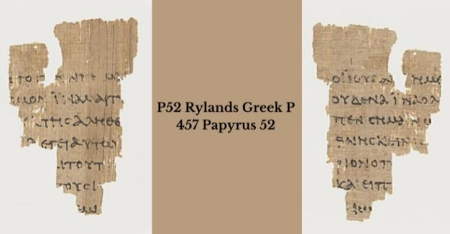
Papyrus 52 (P52) is widely regarded as the earliest known fragment of the New Testament. It is currently housed at the John Rylands Library in Manchester, England.¹ Scholars generally date the fragment to between A.D. 100 and 150, placing it within a few decades of the original Gospel of John.²
The fragment contains portions of John 18:31–33 and 18:37, 38, depicting Jesus standing before Pontius Pilate and discussing the nature of His kingdom and truth -an event central to the crucifixion narrative.¹
The significance of P52 lies in its early dating and its confirmation that the Gospel of John was already in circulation by the early second century. This challenges claims that the New Testament writings were composed much later and supports the historical reliability of the Gospel accounts.³
¹ C.H. Roberts, An Unpublished Fragment of the Fourth Gospel in the John Rylands Library, Manchester University Press, 1935.
² Bruce M. Metzger and Bart D. Ehrman, The Text of the New Testament: Its Transmission, Corruption, and Restoration, Oxford University Press, 2005.
³ Larry W. Hurtado, The Earliest Christian Artifacts: Manuscripts and Christian Origins, Eerdmans, 2006.