
The Case
Does God exist?
When we look at the world, we are all looking for the same thing: the truth about why we are here. While some people think faith is just a "feeling," the evidence for God is actually built on a solid foundation of science, logic, and history.
Using Abductive Reasoning—which is just a fancy way of saying we are looking for the "best explanation" for the facts—the evidence points clearly to one conclusion.
The Universe Had a Beginning
For most of history, people figured the universe had just always been here — no start, no end, simply eternal. Then modern science turned that idea on its head.
Here are five clues that point to a beginning:
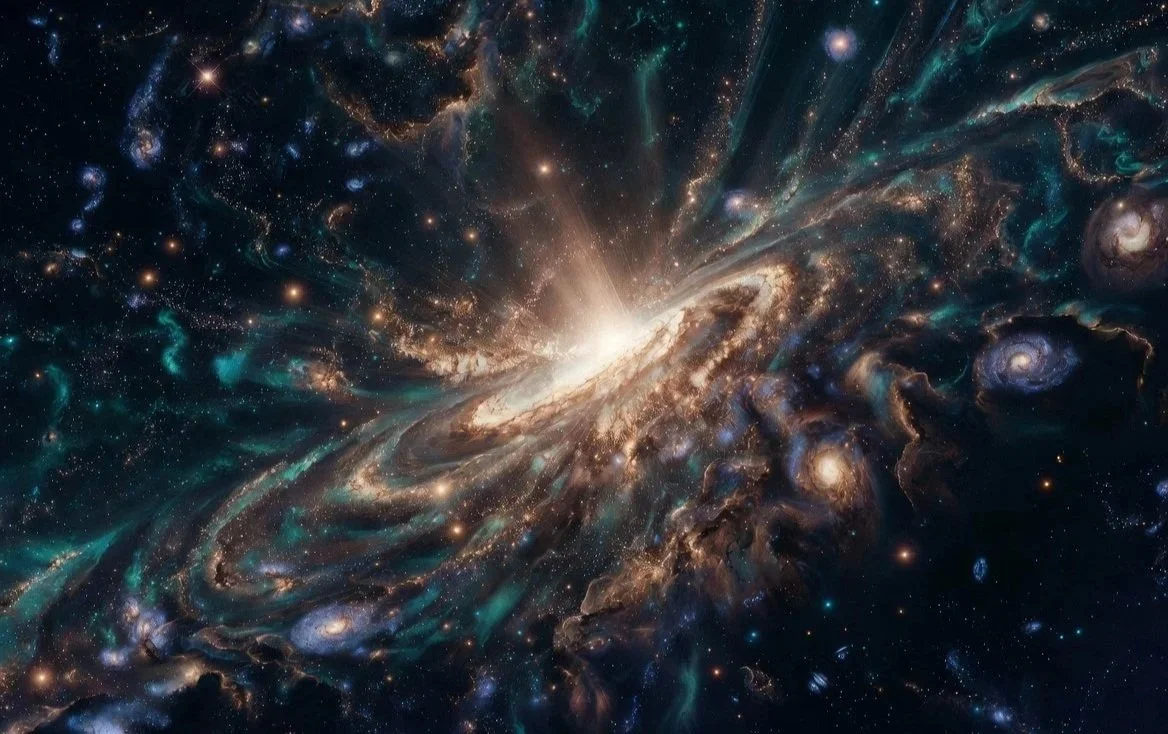
By observing distant galaxies, astronomers discovered that they are all moving away from us, and the farther away they are, the faster they recede. Extrapolating this expansion backward in time means the universe was once compressed into a single, infinitely dense point.
In 1964, scientists Arno Penzias and Robert Wilson accidentally discovered a faint heat signature filling the entire sky — leftover radiation from the universe's first flash of light. They later won the Nobel Prize for finding this "afterglow" of the beginning. This afterglow is one of the strongest pieces of evidence that the universe had an actual starting point, not an eternal past.
In plain terms, the universe is steadily running out of usable energy, like a wind-up clock slowly unwinding. If the universe were infinitely old, all its energy would already be used up by now. Since it isn't, the clock must have been wound up at some point — a beginning.
Albert Einstein's equations showed that time, space, and matter are linked and interdependent. Since matter had a beginning, it follows that time itself had a beginning as well.
Here's a puzzle that doesn't even need a telescope. If the past went back forever — an endless string of days with no starting point — then to arrive at today, you'd have to cross an infinite number of days first. But you can never finish crossing something infinite, any more than you could count down from infinity and reach zero. So if we made it to today (and here we are), the past can't stretch back forever. There had to be a start.
The Best Explanation
Things don't pop into existence on their own. If the universe had a beginning, it had to have a cause. Since time, space, and matter all started at that moment, the thing that caused it must be outside of time, space, and matter.
That sounds exactly like God.
Fine-Tuning
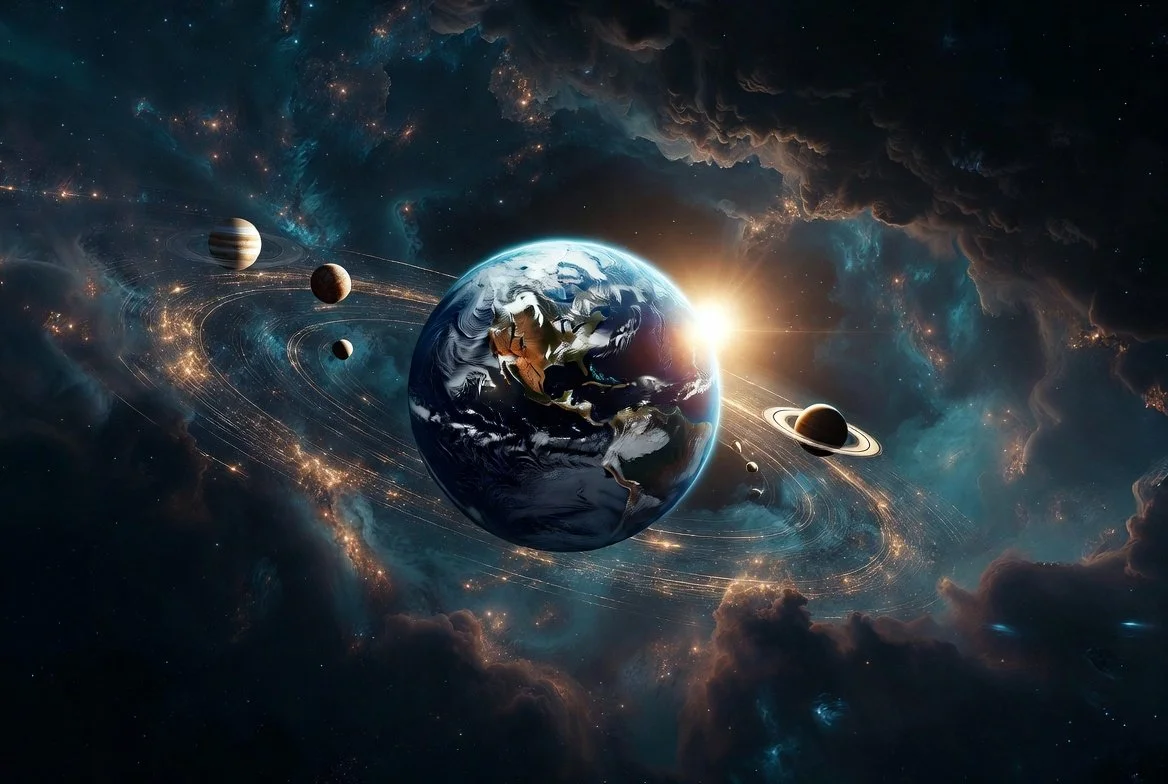
For life to be possible at all, dozens of cosmic settings had to be exactly right. Every one of them is — some to a precision beyond anything you could picture.
When scientists call the universe "fine-tuned," they don't mean comfortable or convenient. They mean something far more startling. The basic numbers built into physics — the strength of gravity, the force holding atoms together, the rate the universe expands — could have been almost anything. Yet they all sit inside the narrow band that makes stars, chemistry, and ultimately life possible. Nudge most of them even slightly, and you get a dead universe: no stars, no atoms, no one here to ask why.
There are two layers to this, and you need both.
The Fine-Tuning of Our Universe
Right after the universe began, it started expanding — and the speed had to be almost unbelievably exact. A hair too fast, and matter would have flown apart into thin, cold gas before a single star could form. A hair too slow, and gravity would have yanked everything back into a crash. Picture balancing a pencil perfectly on its tip and having it just... stay there. That's the kind of precision we're talking about.
Gravity has to fall within a certain range. If it were too weak then stars and planets never form; too strong and stars burn out in a flash, leaving no time for life.
The force that binds electrons to atoms and makes all chemistry and light possible; tuned even slightly differently, atoms and molecules couldn’t hold together.
The “glue” that holds the cores of atoms together; a touch weaker and only hydrogen could exist, a touch stronger and the universe would have burned its hydrogen away long ago.
Water’s lopsided electric charge is why it dissolves the nutrients life needs and why ice floats instead of sinking, letting life survive beneath frozen surfaces.
A neutron is just barely heavier than a proton, and that tiny difference is what lets stable atoms — and shining stars — exist at all.
Deep inside stars, carbon and oxygen (the core ingredients of life) are forged through energy levels so finely set that a small change would leave the universe with almost none of one or the other.
The Fine-Tuning of Our Planet
How far Earth orbits from the Sun, placing it in the narrow “habitable zone” where it’s neither too hot nor too cold for liquid water.
Earth’s unusually large moon drives the ocean tides and, on the leading explanation, steadies Earth’s tilt so the climate doesn’t swing to extremes.
How round Earth’s path around the Sun is; a more stretched-out orbit would swing us between scorching and freezing extremes.
The angle Earth leans as it spins, which gives us mild, stable seasons instead of brutal ones.
How thick Earth’s outer rock layer is; the right thickness balances volcanic activity and the gases the air needs.
How long a day lasts; a much slower or faster spin would bring extreme temperature swings or violent winds.
The balance of sea to dry land, which steadies the climate, rainfall, and temperature worldwide.
The amount of ozone high above us, which shields the surface from the Sun’s harmful ultraviolet rays.
The mix of the two main gases in the air; the right balance lets us breathe without making the air dangerously flammable.
How much carbon dioxide the air holds; enough to keep the planet warm and feed plants, but not so much that it overheats.
The Best Explanation
This level of precision doesn't happen by accident. It points to an Intelligent Designer.
DNA: The Software of Life
The most sophisticated code ever discovered wasn’t written by humans — it was written inside them.
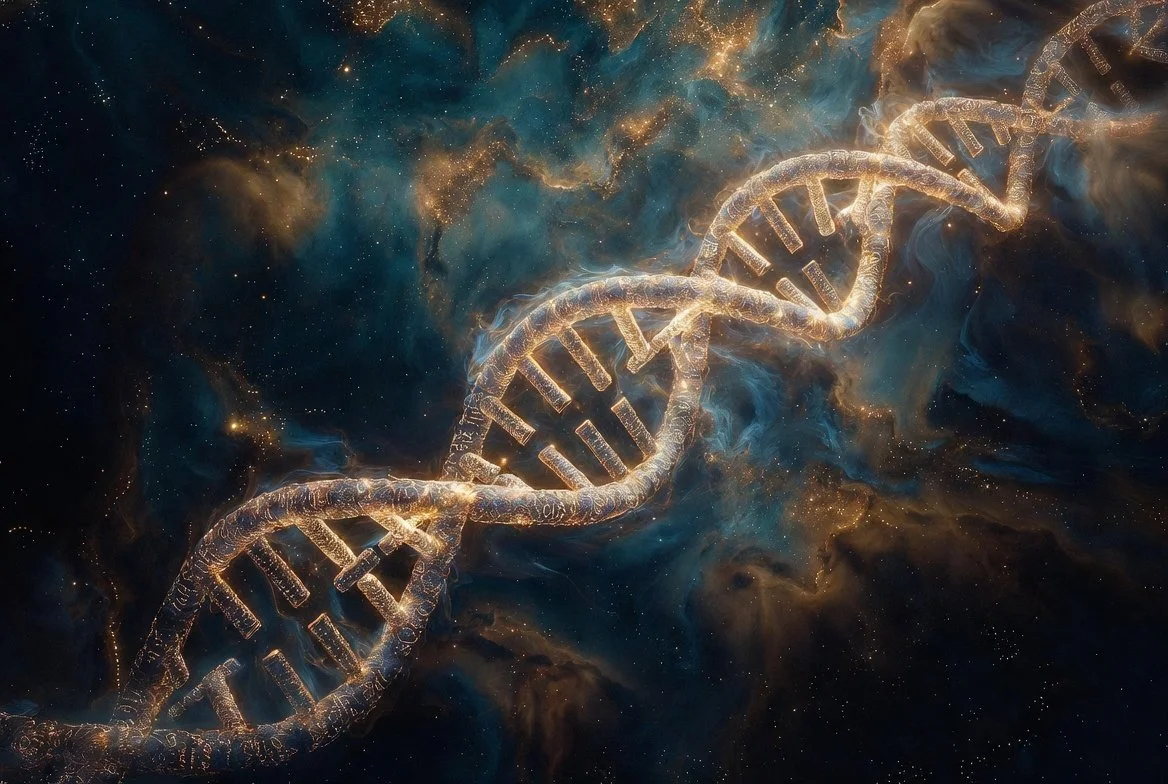
Inside every one of your cells is a set of instructions written in a four-letter chemical alphabet. We call it DNA, but it behaves less like "stuff" and more like language — a digital code that spells out how to build and run a living thing. And everywhere else we look, that kind of coded information has only ever come from one place: a mind.
DNA uses a four-letter alphabet — A, T, C, and G — arranged in a precise order to spell out instructions, just like letters form words and words form sentences. Change the order and you change the meaning, exactly the way rearranging letters changes a word.
The code isn't a vague or blurry signal — it's exact and digital, much like the 1s and 0s running your phone. Bill Gates once noted that DNA works like a computer program, only far more advanced than anything people have ever written.
DNA is the most compact information storage known to exist. Scientists have used it to record entire books and images, and a single gram can hold more data than millions of hard drives.
Like spellcheck on your computer, your cells have built-in machinery that proofreads the code and repairs errors as it copies itself. A system that catches and fixes its own mistakes is a fingerprint of design, not accident.
In all of recorded history, every language, every code, and every instruction manual — from ancient writing to modern software — has come from an intelligent source. We have never once watched information like this write itself.
The Best Explanation
A code requires a coder, and a language requires an author. The digital code written into every living cell is powerful evidence of an intelligent Mind behind life.
The Moral Code Written on Our Hearts
If right and wrong are just opinions, then no opinion is ever truly wrong — not even the worst things human beings have ever done.
You have never met anyone — in any country, in any century — who thought that torturing a child for fun was a good thing. Cultures differ on a thousand things, yet beneath all of it runs a shared conviction that some acts are genuinely right and others genuinely wrong. That conviction is easy to feel and surprisingly hard to explain. Where does it come from — and why does it feel binding on all of us, whether we like it or not?
Cruelty to an innocent person isn't merely unpopular or against the rules — it's wrong everywhere, for everyone, in every era. Deep down we don't treat that as an opinion; we treat it as a fact.
When someone says "That's not fair!" they expect the other person to already know the standard they're appealing to. We don't invent that standard in the moment — we point to one we assume we both already answer to.
Someone might insist morality is just personal opinion — until you break a promise to them or treat them unfairly. The moment it costs them, they appeal to a real right and wrong, exactly like everyone else.
Cultures disagree about plenty, but the core rules — don't murder the innocent, keep your word, protect your children — appear across history and around the globe, as if everyone is reading from the same hidden page.
The Best Explanation
A real law that holds for everyone requires a Lawgiver who stands above everyone. The moral sense written on every human heart points to a personal, good God.

The Bottom Line
When you add up the evidence from the beginning of the universe, the perfect "fine-tuning" of our planet, the complex code in our DNA, and the moral laws in our hearts, the picture becomes clear.
It is much more reasonable to believe that an intelligent, powerful, and personal Creator put this all together than to believe it all happened by sheer, impossible luck.